
How softgels are made — and what separates a good one.
A softgel looks simple: a glossy capsule you swallow whole. Inside that simplicity is one of the most precise oral dose forms ever invented — a sealed liquid dose with no measuring, no spilling, and no aftertaste. Here is how softgels are actually made, what changes when the fill is cannabis distillate, and the few details that decide whether a batch is excellent or merely passable.
What is a softgel, exactly?
A softgel — short for soft gelatin capsule, also called a soft elastic capsule — is a one-piece, hermetically sealed shell that encloses a liquid or semi-solid fill. That single sealed seam is the whole point. Unlike a two-piece hard capsule that snaps together and can be pulled apart, a softgel is formed and filled in the same instant and welded shut, so it holds oils and other liquids that a hard capsule can't. The shell is built to be swallowed whole; it dissolves in the gut and releases the fill.
That construction is why softgels are the format of choice for oil-soluble actives — fish oil, vitamin D, and, increasingly, cannabis. A cannabinoid distillate is an oil. It belongs in a softgel for the same reason omega-3 does: the dose is pre-measured, protected from air and light, and tasteless going down.
How are softgels made?
The dominant method, used for the overwhelming majority of softgels worldwide, is rotary die encapsulation — a process invented by Robert Pauli Scherer in 1933 that still defines the industry. It runs as one continuous, synchronised motion:
1. The gel mass. The shell starts as a hot, molten gel: a gelling agent, a plasticiser (typically glycerin or sorbitol) to keep the shell flexible, water, and any opacifier or colour. The water is what makes it pourable; almost all of it is driven off later in drying. Get this recipe wrong and every step downstream suffers.
2. Casting the ribbons. The molten gel is cast onto chilled drums, where it sets into two thin, continuous ribbons of shell material. These ribbons are the future top and bottom halves of every capsule.
3. Fill metering. The two ribbons travel toward each other and meet over a pair of counter-rotating dies. At the exact moment the die pockets line up, a precision positive-displacement pump injects a measured shot of fill between the ribbons. This metering pump is the heart of dose accuracy — it decides how many milligrams go into each capsule.
4. Forming and sealing. As the dies rotate, they press the two ribbons together around the fill, cut each capsule free, and heat-seal the seam in one stroke. The capsule is formed, filled, and welded shut simultaneously. The just-made softgels drop away from the ribbon web.
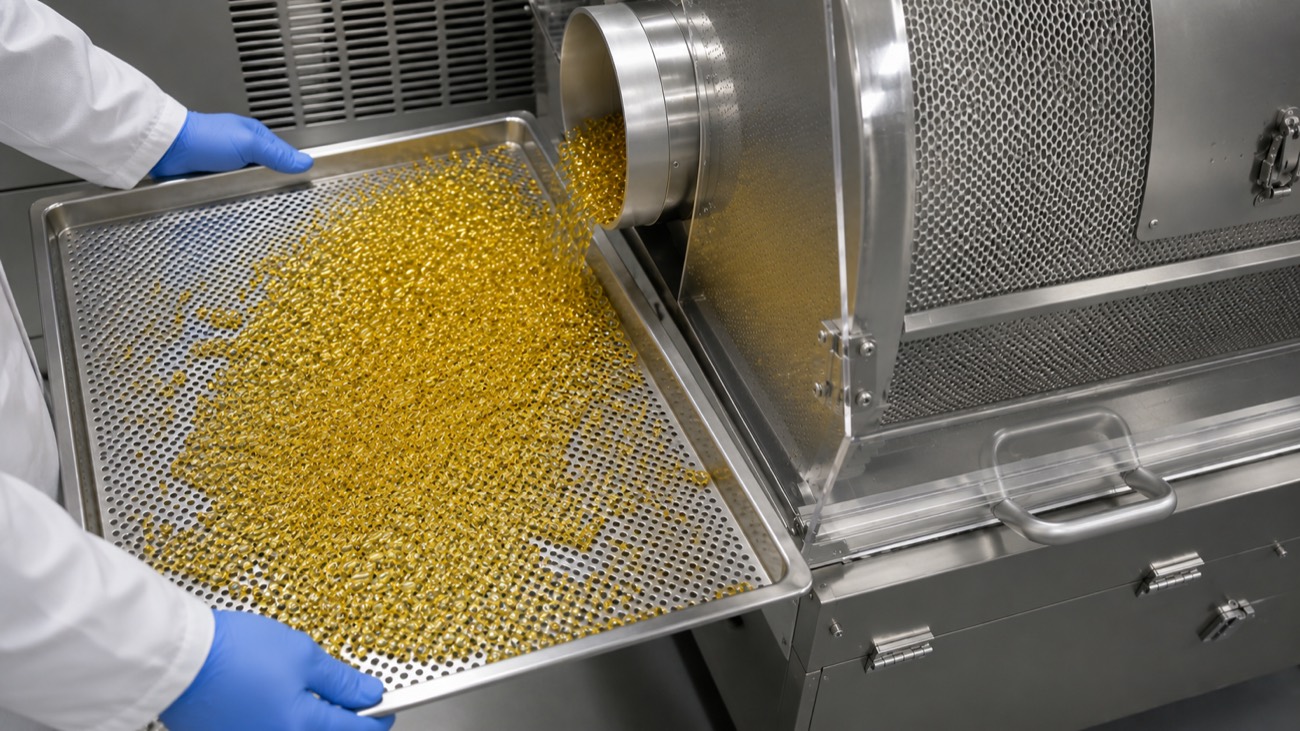
5. Drying. Fresh softgels are soft and wet — full of the water that made the gel pourable. They are tumble-dried in rotating baskets, then spread on trays to cure down to a target shell moisture. Drying is slow and unglamorous, and it is where a careless run is quietly ruined: too hot and shells crack, too humid and they stay soft and weep.
6. Inspection and finishing. Dried softgels are inspected for leakers, shape and fill defects, then washed, polished, and sent for testing and packaging. Only now does the lot get its certificate of analysis.
Gelatin or vegan? What the shell is made of
Traditional softgel shells are made from gelatin — a protein rendered from bovine or fish collagen. Gelatin forms a strong, glossy, fast-dissolving shell, which is why it has dominated for ninety years. The trade-off is dietary: bovine gelatin is neither vegan nor, depending on sourcing, reliably halal or kosher.
Vegan (plant-based) softgels replace the animal gelatin with hydrocolloids such as modified starch or carrageenan. They open the product up to vegan, vegetarian, halal and kosher buyers — a meaningful share of the cannabis wellness market — at the cost of a more demanding formulation and drying process. For a brand, the shell decision is a positioning decision as much as a technical one: it determines who is allowed to buy your product.
Why does softgel potency vary between batches?
Here is the part that surprises people: two softgels labelled the same can legitimately contain slightly different amounts of active. That isn't sloppiness — it's the nature of dosing a real material at milligram scale.
With cannabis, the source of the variance is the fill. A cannabinoid distillate is a viscous oil whose exact potency shifts lot to lot, so the formulator has to assay each lot and adjust the recipe to land the labelled dose. Then the metering pump has to deliver that fill within a tight window, capsule after capsule, while the fill's viscosity changes with temperature. A fraction of a milligram of drift moves the number.
In Canada, that window is set by law. Under section 97 of the Cannabis Regulations, a cannabis product must contain between 85% and 115% of the THC or CBD shown on the label — a ±15% band. For ingested cannabis extracts like a swallowed softgel, each unit is also capped at 10 mg of THC, with a maximum of 1,000 mg of THC per package. A competent manufacturer doesn't aim for the edges of that band — it targets the centre and holds it, every batch, so the label is honest and the lot passes. How a manufacturer actually holds that tolerance is the real measure of the craft.
What does softgel colour tell you about quality?
A softgel shell is translucent, so it shows whatever is inside it. That makes colour one of the few quality signals a buyer can read with the naked eye — and one of the most misread.
Batch-to-batch colour drift in a finished softgel is almost never a shell problem. It's an input problem. A clean, well-refined cannabinoid distillate is a clear, bright gold; a less-refined or oxidised oil runs dark amber to brown. A pure isolate is a true white powder; a poorly cleaned one is off-white or grey. So when a softgel's colour wanders from lot to lot, it's usually telling you the extract underneath wasn't consistent. The fix lives upstream, in extraction and remediation — a controlled de-waxing and colour-removal process that strips waxes and colour without sacrificing yield. Start from golden distillate and white isolate and the shelf colour stays consistent on its own. Colour, in other words, is visible proof of input purity.
What "fill weight tolerance" means for your label
Dose is one tolerance; net weight is another, and they have to be satisfied at the same time. Health Canada's tolerance limits for declared net weight allow a discrete unit at softgel size — well under two grams — to vary within 10% of its declared weight (the allowance tightens to 5% for units over two grams). Because the cannabinoids ride in the fill, fill weight and potency move together: tune the metering to fix one and you shift the other. Holding both bands at once, batch after batch, is the part of softgel manufacturing that experience actually buys you.
Softgels vs oils vs edibles: which is most precise?
For a brand choosing a format, dosing precision and shelf life usually decide it:
Versus tincture oils: a dropper asks the consumer to measure, in a dim bathroom, by counting drops — and drop size varies. A softgel is the dose, pre-measured and identical every time. For anyone who wants a reliable, repeatable amount, the softgel wins on precision outright.
Versus edibles: gummies and chocolates are pleasant but expose the active to heat, moisture, flavours and sugars, and Canadian edibles are capped at 10 mg THC per package. An ingested softgel extract can carry up to 10 mg per unit and 1,000 mg per package — far more dosing range — inside a sealed shell that keeps oxygen and light off the cannabinoids.
The shared advantage: the sealed shell is a barrier. Cannabinoids degrade with exposure to air and light; a softgel locks the oil away from both, which is why softgels tend to hold their labelled potency longer than an oil in a part-used bottle. Precise, portable, tasteless, and protected — that combination is why softgels keep taking share in cannabis wellness.
Why leakers are the real yield killer
Ask any softgel maker what keeps them up at night and the answer is leakers. A leaker is a capsule whose seam lets fill escape — and at scale, leakers are the single biggest threat to yield, and therefore to unit cost. They come from a handful of causes: a seam sealed too thin, a fill chemically incompatible with the gelatin, or a drying window run too hot or too wet. Oil-based cannabis fills make every one of those failure modes live. This is why a controlled, well-characterised fill-and-drying process matters more than the machine itself: it's what protects your yield, and your economics, once you're running tens of thousands of units.
What to look for in a cannabis softgel manufacturer
If you're choosing a contract manufacturer for softgels in Canada, the questions that separate marketing from capability are concrete. Ask for the published minimum order quantity and turnaround time — many won't state them. Ask how they hold the ±15% potency band and the net-weight tolerance, batch to batch, on a lot-variable distillate. Ask where their distillate comes from and how they control its colour. Ask for their Health Canada audit history and whether there have been critical findings. And ask whether a real person follows up — or a form.
Lupos answers all of these in the open. We publish our specs, hold both legal tolerances every batch by assaying each distillate lot and holding the centre of the band, and start from golden distillate and white isolate so colour stays consistent on the shelf — with audit context and batch documentation shared openly during scoping.
Start this project
Building a cannabis softgel program, or moving one to a manufacturer that publishes its numbers? A real person follows up, not a bot. Email info@lupos.ca or start a project at lupos.ca.
See softgel contract manufacturing →
Related services & reading
Softgel Contract Manufacturing · Tolling, Distillates & Isolates · Topicals & Oils Manufacturing